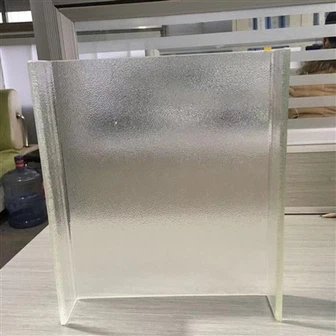
How can we enrich the color of colored U-shaped glass?
Among the vast array of glass, in addition to the colorless, transparent glass commonly seen in everyday life, there are also numerous colored glass options, including black glass, such as purple-black for car windows and blue architectural glass.
To meet the needs of customers for their overall decorative color, Xiangjie U-shaped Glass's R&D department has, through continuous experimentation, successfully developed a variety of colors to meet local color design requirements, and is now used in numerous domestic projects.
While ordinary U-shaped glass appears bright and transparent from the front, it takes on a slightly bluish hue near the edges. Because the color of glass depends on the purity and iron content of quartz sand, the primary raw material for making it, a small amount of manganese dioxide or selenium is added to create colorless U-shaped glass.
Some darker colors are also available for decorative purposes, but since the requirements are less stringent, we only produce them occasionally. However, the current design requirements for colored U-shaped glass require highly rigorous scientific research, and production is only possible after the secrets of U-shaped glass color are revealed.
Research has found that by adding 0.4-0.7% of a colorant to ordinary glass, U-shaped glass can be tinted. The colorants are primarily metal oxides. As we know, each metal element has its own unique "spectral signature," resulting in different metal oxides producing different colors.
Adding these oxides to the glass creates a tinted glass. Currently, rare earth element oxides are used as colorants to create a variety of high-end colored glass. Colored glass doped with rare earth elements exhibits vibrant, clear colors and even changes color under varying lighting conditions. In addition to rare earth elements, tungsten and platinum can also be added directly to the glass to create color-changing glass.