

Tempered U channel glass is annealed channel glass that has undergone a second heat treatment in a tempering oven to strengthen the glass and raise the compression to 10,000 psi or greater. Tempered channel glass is three to five times stronger than annealed channel glass and is recognized by its break pattern - relatively small, harmless fragments. This phenomenon, called "dicing," markedly reduces the likelihood of injury to people as there are no jagged edges or large, sharp shards.
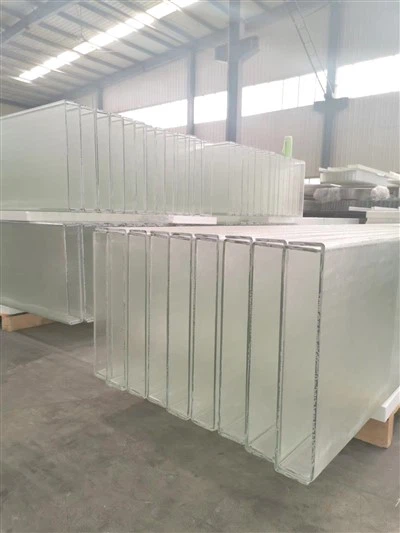


Advantages of Tempered U Profile Glass
Safer
The biggest advantage of tempered u profile glass over annealed or “ordinary” glass is that it was designed for safety. Unlike annealed glass, which breaks into large and dangerous shards, tempered u profile glass disintegrates into small granular chunks that are relatively harmless.
Tougher
The thermal tempering process used to manufacture tempered u profile glass makes it much stronger than ordinary glass. Tempered u profile glass can stand up to strong winds, direct impact from blows and bumps, and minor explosions.
Heat-resistant
Tempered u profile glass can resist temperatures of up to 470 degrees fahrenheit. This property makes tempered u profile glass ideal for use in kitchen appliances and in areas like the bathroom, where it will likely be in contact with the heat on a regular basis.
Crystal clear
While the tempering process makes tempered u profile glass super tough, it doesn't affect the clarity of the glass. Tempered u profile glass is crystal clear and transparent, which makes it useful in windows, display cases, and glass doors.
Versatile
Tempered u profile glass can be used practically anywhere glass is needed. It makes for an attractive and sturdy frameless shower door, a fully transparent smartphone screen protector, and a seamless stovetop base.
Doesn't scratch easily
The manufacturing process that makes tempered u profile glass thermally tough also makes it scratch-resistant. This makes tempered u profile glass an ideal material for glass doors, kitchen appliances, mobile screen protectors, and passenger vehicle windows.
Available in various designs and patterns
Tempered u profile glass can be clear, frosted, engraved, stained, and patterned. It's available in an array of patterns and designs to suit your needs.
Why Choose US
Our Factory
Yongyu Glass was founded by Gavin Pan, who has worked in the architectural glass industry since 2006 and has more than fifteen years' North American and E.U. market export experience. The company was established with a wish to integrate the advantage resources of building the region's glass industry and provide personalized solutions to the needs of our customers. We find personalized solutions for the customers' demands and help customers save time and money.
Our Product
High-performance low iron U glass systems.
(U glass, also called U channel glass/U profile glass/C-glass).
Ice rink glass system (1/2", 5/8" tempered glass, laminated glass).
Jumbo safety glass.
(Jumbo tempered glass, Jumbo tempered laminated glass, Jumbo IGU).
Curved safety glass.
(Curved tempered glass, Curved tempered laminated glass, Jumbo curved safety glass max 12.5 meters tall).
SGP laminated glass.
Rich Experience
Engaged in the architectural glass industry and served customers both home and abroad for more than 15 years.
Help glass facades companies and architectural designers find personalized solutions and help them save time and money.
Our Service
We are SGCC approved supplier; our products are meet the primary standards of building glass products. Convenient communication, the whole production process can be traced back, 7*24h after-sale service is our promise.
Working Principle of Tempered U Profile Glass
Tempered or tempered u profile glass is a type of safety glass processed by controlled thermal or chemical treatments to increase its strength compared with normal glass. Tempering puts the outer surfaces into compression and the interior into tension. Such stresses cause the glass, when broken, to shatter into small granular chunks instead of splintering into large jagged shards as ordinary annealed glass does. These smaller, granular chunks are less likely to cause deep penetration when forced into the surface of an object (e.G. By gravity, by wind, by falling onto them, etc.) compared to larger, jagged shards because the reduction in both the mass and the maximum dimension of a glass fragment corresponds with a reduction in both the momentum and the penetration depth of the glass fragment.
Thermally toughened u glass is specially designed to satisfy increased safety requirements within common areas of public buildings. This product variant provides greater mechanical strength compared to its annealed version, allowing the creation of large surfaces that are bright while also meeting all safety requirements. In addition, it allows for longer installation lengths compared to standard anneal u glass products. Heat-soaked thermally toughened glass is available upon request.
Glass colour ceramic frit glass is toughened as a matter of course during the enameling process. Toughening is offered for all u-channel glass surface textures in lengths up to 8 meters. The toughened glass can also be sandblasted for a matt finish or painted.
Glass safety u glass could be heat soak tested to minimize spontaneous breakages risk from nickel sulfide inclusions. It is specifically designed to test u-channel glass and is subject to regular independent inspection and testing.

How Is Tempered U Profile Glass Made
Testing the glass involves punching it to make certain that the glass breaks into a lot of small, similarly sized pieces. One can ascertain whether the glass has been properly tempered based on the pattern in the glass breaks.
Tempered u profile glass is about four times stronger than "ordinary," or annealed, glass. And unlike annealed glass, which can shatter into jagged shards when broken, tempered u profile glass fractures into small, relatively harmless pieces.
To prepare glass for the tempering process, it must first be cut to the desired size. (strength reductions or product failure can occur if any fabrication operations, such as etching or edging, take place after heat treatment.) the glass is then examined for imperfections that could cause breakage at any step during tempering. An abrasive¿such as sandpaper¿takes sharp edges off the glass, which is subsequently washed.
Next, the glass begins a heat treatment process in which it travels through a tempering oven, either in a batch or continuous feed. The oven heats the glass to a temperature of more than 600 degrees celsius. (the industry standard is 620 degrees celsius.) the glass then undergoes a high-pressure cooling procedure called "quenching." during this process, which lasts just seconds, high-pressure air blasts the surface of the glass from an array of nozzles in varying positions. Quenching cools the outer surfaces of the glass much more quickly than the center. As the center of the glass cools, it tries to pull back from the outer surfaces. As a result, the center remains in tension, and the outer surfaces go into compression, which gives tempered u profile glass its strength.
Glass in tension breaks about five times more easily than it does in compression. Annealed glass will break at 6,000 pounds per square inch (psi). Tempered u profile glass, according to federal specifications, must have a surface compression of 10,000 psi or more; it generally breaks at approximately 24,000 psi.
Another approach to making tempered u profile glass is chemical tempering, in which various chemicals exchange ions on the surface of the glass in order to create compression. But because this method costs far more than using tempering ovens and quenching, it is not widely used.
Fixed profiles: Aluminum profiles or other metal profiles shall be fixed on the building with stainless steel bolts or rivets, and the frame material shall be firmly fixed with the wall or building opening, with no less than 2 fixed points per linear meter.
Glass into the frame: Clean the inner surface of the U-shaped glass, insert it into the frame, cut the buffering plastic part into corresponding length and put it into the fixed frame.
When the U-shaped glass is installed to the last three pieces, first put two pieces of glass into the frame, and then seal with the third piece of glass; If the residual width of the hole can not be put into the whole glass, the U-shaped glass can be cut along the length direction to meet the residual width, and the cut glass should be installed first.
The gap between the U-shaped glasses should be adjusted according to the temperature when the temperature difference increases;
When the horizontal width of U-shaped glass is more than 2m, the horizontal deviation of transverse member can be 3mm; When the height is not more than 5m, the perpendicularity deviation of the frame is allowed to be 5mm; When the height is not more than 6m, the span deflection of the member is allowed to be 8mm;
The gap between the frame and the U-shaped glass shall be filled with an elastic pad, and the contact surface between the pad and the glass and the frame shall not be less than 12mm;
When Can Glass Be Cut
Any shaped glass units, glass panels with cutouts, or glass cut to non-square shapes can be cut to the size and shape you require, but it must be done before the glass is put through any toughening process. It is important to consult with a specialist early on in the project to ensure the panels can be designed and cut to the right size and shape in the first place.
Once the glass has been cut to the required shape, it is then placed in a furnace where the toughening process takes place. The panels are heated to 600 degrees, and then rapidly cooled with cold air. This rapid cooling contracts the surface of the glass, putting it in a state of compression whilst leaving the inside of the glass in a state of tension. The glass is much stronger under compression, and in order to break it, the compressive force must first be exceeded.
Once you temper a piece of glass, it is not possible to cut it again without shattering it or leaving it weakened and unfit for its original purpose. This involves heating the glass in a kiln and then letting it slowly cool over a course of eight or nine hours. After you anneal it, you might be able to cut it into the size and shape you're looking for. However, in doing so you are essentially removing the temper and returning it to its previous state as “ordinary” glass, which means it will lose its ability to shatter into grain-like pieces, and can no longer be considered safety glass.

When the height of the roof glass is greater than 5m from the ground, toughened laminated glass must be used, and the thickness of the laminated film should not be less than 0.76mm.
Sightseeing elevator and its peripheral protection.
Ground panel used to withstand pedestrian walking.
Windows are opened outside buildings with floors 17 and above. If insulating glass is used, safe insulating glass should be used; in the case of double glazing, both sides are toughened glass in principle; safety glass is not required for sliding windows (glass area less than 1.5 square meters).
Window glass with an area of more than 1.5 square meters or floor-to-ceiling window with the bottom edge of glass less than 500mm from the decoration surface; regardless of the number of layers and height, glass conforming to this line shall be safety glass. No matter the size of the frameless glass door, the thickness of tempered glass should be no less than 10mm.
Glass curtain wall refers to the glass curtain wall composed of glass ribs and glass panels, you do not need to use toughened glass. Commonly used metal frame glass curtain walls (including point glass curtain walls) must use safety glass.
Aquarium and swimming pool observation window, observation hole; toughened laminated glass should be used for underwater glass.
Entrances and exits of public buildings, foyers, etc. If the ground floor entrance foyer of the dwelling unit is enclosed by a glass partition, the glazing shall be safety glazing.
Indoor partition, bathroom enclosure and screen. If the window sill is lower than the stipulated requirements (less than 0.8m for public buildings, less than 0.9m for residential buildings), if the lower part of the window is set equal to the height of the railing, there are fixed windows with window frames around as protective measures, and the glass is laminated glass, the thickness is not less than 6+6mm, then there is no need to make the railing. If the height of the window is below 0.9m, it must be made of railings. Residential balcony sliding doors with glass area less than 1.5 square meters can be done without safety glass.
Stair, balcony, platform corridor and atrium corridor; for glass railings that do not bear horizontal load, it is recommended to use tempered laminated glass. If the glass can be fixed around the glass and is only used for enclosure, the thickness of the glass railings bearing horizontal load is recommended to be 6+6mm. When the glass is located at a building height of 5m or above, the thickness of tempered laminated glass should be no less than 12mm (the specific thickness should be determined according to the calculation of thrust and span, etc.).
Tempered laminated glass shall be used for other parts that are vulnerable to impact or impact and may cause human injury. The recommended thickness of ordinary glass canopy is 12 (top) +8 (bottom) mm, and the recommended thickness of glass sheet is 6+6mm.
Because the selection of glass should pay attention to its large allowable area and thickness, the relationship between types, the structure professional has calculated the wind load of each height of multi-storey and high-rise buildings, you can safely use toughened glass.
FAQ
As one of the leading tempered u profile glass manufacturers and suppliers in China, we warmly welcome you to wholesale high quality tempered u profile glass at competitive price from our factory. For more information, contact us now.
Impact Resistant U Channel Glass, heat resistance of tempered u profile glass, Tempered C Channel Glass