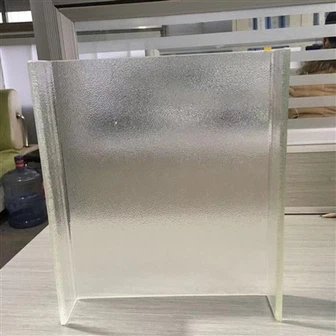
Raw materials and ingredients of U-shaped glass
In today's building materials field, the application of U-shaped glass has become more and more extensive. Compared with traditional ordinary glass, U-shaped glass has the characteristics of light transmission, no perspective, a beautiful appearance, and higher strength. So what raw materials are needed to produce U-shaped glass? What role do these raw materials play?
In order to restore liquid glass to the glass state we are familiar with, we need to cool the liquid glass quickly. After rapid cooling, the molecular structure is rearranged between liquid and crystal, which becomes what we often call glass.
It is not difficult to see that glass is not a solid or liquid that we come into contact with in daily life. It is a semi-solid and semi-liquid state with a very slow flow rate, which is very special. Therefore, in the process of making glass, how to control the temperature has become a top priority.
Next, let's talk about the ingredients and raw materials of U-shaped glass. Generally speaking, U-shaped glass is mainly composed of the following four ingredients.
1. Basic ingredients
Like most ordinary glass, the basic chemical composition of U-shaped glass also includes four elements: silicon dioxide, sodium oxide, calcium oxide, and magnesium oxide.
Silicon dioxide is the main component of glass and comes from quartz sand. It has very good durability, but its melting point is too high. It is very difficult to make glass with silicon dioxide alone.
So people add sodium oxide, which can effectively reduce the melting point of quartz sand, which is the raw material of silicon dioxide. However, due to the presence of sodium ions, it is chemically more active and easily reacts with the outside world. In industrial materials, soda ash can provide a large amount of sodium oxide.
Calcium oxide is another important component that enhances the durability of glass. However, it can easily cause crystallization of liquid raw materials at high temperatures, causing the glass to lose its light transmittance. There is a large amount of calcium oxide in limestone and dolomite.
In order to solve this problem, magnesium oxide is often added to the raw materials to prevent the glass from crystallizing at high temperatures. Dolomite can provide a large amount of magnesium oxide.
The above four elements are the basic components of most glasses, and the glass produced is what we often call sodium calcium silicate glass.
2. Trace ingredients
In addition to the basic elements mentioned above, U-shaped glass will also add some auxiliary materials as needed. The most commonly used is alumina, which is used to effectively increase the moisture resistance of glass. Furthermore, when producing ordinary white U-shaped glass, adding iron red powder can effectively remove bubbles formed by carbon dioxide in the raw materials, making the glass clearer. However, iron red powder causes glass to be colored, so it cannot be used in ultra-white U-shaped glass raw materials.
Adding some oxidants can make the glass more crystal clear. If there are special needs, you can also add an appropriate amount of colorants to change the color of the glass, such as cobalt, selenium, nickel, etc.
3. Clarifier
In industrial production, a certain amount of Glauber's salt needs to be added to the glass raw materials as a clarifier, which can effectively discharge gases such as carbon dioxide contained in liquid glass and make the glass clearer.
4. Broken glass
The purpose of adding broken glass to the raw materials is to effectively reduce the melting point of the raw materials and make the raw materials easier to process.
In this way, according to the needs, the four types of raw materials mentioned above are weighed and mixed according to different proportions, sent to the furnace, and after product molding, annealing, cooling, and cutting, the final U-shaped glass can be obtained.
In industry, U-shaped glass can also be subjected to some deep processing, such as tempering, sandblasting, high-temperature colored glaze, etc., to achieve the desired use effect.