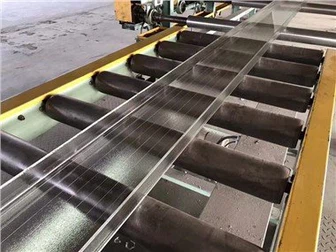
Factors that cause stress spots in tempered glass
Other factors that cause stress spots in tempered glass
1. Observation angle
We can see stress spots because natural light in the visible light band is polarized when passing through glass. When light is reflected from the surface of the glass (transparent medium) at a certain angle, part of the light is polarized. Similarly, part of the refracted light passing through the glass is also polarized. When the tangent value of the incident angle of the light is equal to the refractive index of the glass, the reflected polarization reaches a maximum value. The refractive index of glass is 1.5, and the maximum incident angle of reflected polarization is 56.
That is, the light reflected from the glass surface at an incident angle of 56o is almost all polarized light. For tempered glass, the reflected light we see is reflected from two surfaces with a reflectivity of 4% each. The reflected light from the second surface farther away from us passes through the stress glass. This part of the light interferes with the reflected light from the surface closer to us on the glass surface to produce colored spots. Therefore, when the incident angle is 56. The stress version is significant when investigating the glass. The same principle applies to tempered insulating glass because there are more reflective surfaces and more polarized light. For tempered glass with the same level of uneven stress, the stress spots we see are clearer and appear heavier.
2. Glass thickness
As light propagates in glass of different thicknesses, the thicker the glass, the longer the optical path, and the more opportunities for light polarization. Therefore, for glass with the same stress level, the thicker the glass, the heavier the color of the stress spots.
3. Glass variety
Different glass varieties have different effects on the stress spots of glass with the same stress level. For example, the color of the stress spots of borosilicate glass will appear lighter than that of soda-lime glass.
Due to the particularity of the strengthening principle of tempered glass, it is very difficult to eliminate stress spots. However, by selecting advanced equipment and reasonably controlling the production process, the generation of stress spots can be reduced to a level that does not affect the aesthetic effect.