

What is the bending radius if Ultra Clear U Profile Glass is bent?
Ultra Clear U Profile Glass is a remarkable building material that combines aesthetics with functionality. One of the key considerations when working with this type of glass is its bending radius. In this blog post, I'll share insights into the bending radius of Ultra Clear U Profile Glass, drawing on my experience as a supplier of this high - quality product.
Understanding Ultra Clear U Profile Glass
Ultra Clear U Profile Glass is known for its exceptional clarity and unique U - shaped profile. It is widely used in architectural applications, such as curtain walls, interior partitions, and decorative elements. The ultra - clear nature of the glass allows for maximum light transmission, creating bright and open spaces. Its U - profile provides structural stability, making it a popular choice for both modern and traditional building designs.
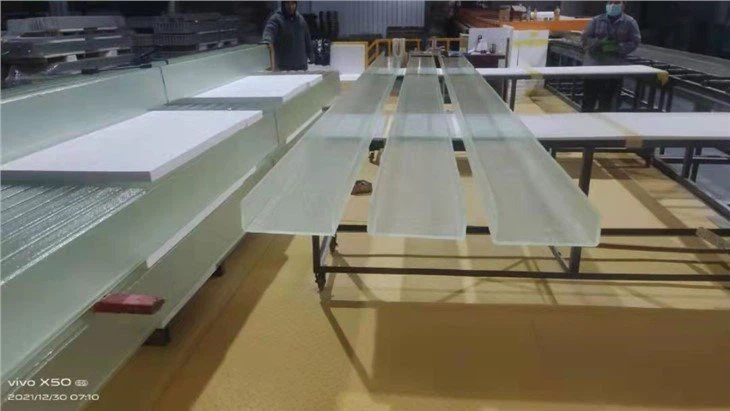

Factors Affecting the Bending Radius
The bending radius of Ultra Clear U Profile Glass is influenced by several factors:
Glass Thickness
Thicker glass generally requires a larger bending radius. As the thickness of the glass increases, its stiffness also increases, making it more difficult to bend without causing damage. For example, a 5mm thick Ultra Clear U Profile Glass may have a smaller bending radius compared to a 7mm thick one. Our 7mm U Profile Glass for Curtain Wall is a high - end option, but due to its thickness, the bending process needs to be carefully calculated to ensure the appropriate radius.
Glass Composition
The chemical composition of the glass can also impact its bending properties. Ultra Clear U Profile Glass is typically made with low - iron content, which enhances its clarity. However, the specific formulation of the glass can affect its ductility and the minimum bending radius it can withstand. Our Low Iron C Glass is formulated to balance clarity and workability during the bending process.
Bending Method
There are different methods for bending glass, including hot bending and cold bending. Hot bending involves heating the glass to a high temperature until it becomes malleable and then shaping it. Cold bending, on the other hand, uses mechanical forces to bend the glass at room temperature. Hot bending generally allows for more complex shapes and smaller bending radii compared to cold bending. However, it requires specialized equipment and expertise.
Determining the Bending Radius
To determine the appropriate bending radius for Ultra Clear U Profile Glass, a combination of theoretical calculations and practical testing is necessary.
Theoretical Calculations
Engineers use mathematical models based on the physical properties of the glass, such as its Young's modulus, Poisson's ratio, and tensile strength, to estimate the minimum bending radius. These calculations take into account the factors mentioned above, such as glass thickness and composition.
Practical Testing
In addition to theoretical calculations, practical testing is crucial. Samples of the Ultra Clear U Profile Glass are bent under controlled conditions to verify the calculated bending radius. This helps to ensure that the glass can be bent without cracking, breaking, or losing its optical clarity.
Typical Bending Radius Ranges
The bending radius of Ultra Clear U Profile Glass can vary depending on the specific application and the glass characteristics. In general, for thinner glasses (e.g., 4 - 6mm), the minimum bending radius can range from 1000mm to 2000mm. For thicker glasses (e.g., 7 - 10mm), the minimum bending radius may be between 2000mm and 3000mm. However, these are just approximate values, and the actual bending radius should be determined on a case - by - case basis.
Applications of Bent Ultra Clear U Profile Glass
Bent Ultra Clear U Profile Glass offers a wide range of design possibilities. It can be used to create curved curtain walls that add a dynamic and modern look to a building. In interior design, bent glass partitions can create a sense of fluidity and elegance. Our Clear Patterned U Channel Glass can be bent to enhance its decorative effect, making it suitable for feature walls and display areas.
Quality Control in Bending
Maintaining high - quality standards during the bending process is essential. As a supplier, we ensure that our bending operations are carried out by experienced technicians using state - of - the - art equipment. We conduct strict quality checks at every stage of the process, from the initial heating of the glass to the final shaping and cooling. This ensures that the bent Ultra Clear U Profile Glass meets the required specifications in terms of optical clarity, structural integrity, and dimensional accuracy.
Challenges in Bending Ultra Clear U Profile Glass
Despite the many benefits of bent Ultra Clear U Profile Glass, there are also some challenges associated with the bending process. One of the main challenges is the risk of optical distortion. If the bending is not done correctly, the glass may develop waves or other visual imperfections that can affect its appearance and performance. Another challenge is the potential for stress fractures during the bending process. These fractures can weaken the glass and reduce its lifespan.
Solutions to Bending Challenges
To address the issue of optical distortion, we use advanced bending techniques and precision equipment. Our technicians are trained to control the bending process carefully to minimize any visual defects. To prevent stress fractures, we conduct pre - bending stress analysis and use appropriate annealing processes after bending. Annealing helps to relieve the internal stresses in the glass, making it more durable.
Conclusion
The bending radius of Ultra Clear U Profile Glass is a critical factor that needs to be carefully considered in architectural and design applications. By understanding the factors that affect the bending radius, conducting accurate calculations and testing, and implementing strict quality control measures, we can provide high - quality bent Ultra Clear U Profile Glass that meets the diverse needs of our customers.
If you are interested in using Ultra Clear U Profile Glass in your project and need more information about its bending capabilities, or if you have specific requirements for the bending radius, please feel free to contact us for a detailed discussion. We are committed to providing you with the best solutions and products for your building and design needs.
References
- Glass Science and Technology Handbook
- Architectural Glass Design and Application Manual