

How is C Channel Glass made?
How is C Channel Glass made?
As a supplier of C Channel Glass, I am often asked about the fascinating process behind its creation. In this blog, I'll take you through the journey of how C Channel Glass is made, from the raw materials to the finished product.
Raw Materials
The first step in making C Channel Glass is gathering the necessary raw materials. The primary ingredient is silica sand, which makes up about 70% of the glass composition. Silica sand provides the basic structure of the glass. Along with silica sand, other materials are added to modify the properties of the glass. These include soda ash (sodium carbonate), which lowers the melting point of the silica sand, making it easier to work with. Limestone (calcium carbonate) is also added to increase the chemical durability of the glass.
In addition to these main components, small amounts of other substances such as alumina and magnesium oxide may be included to enhance specific characteristics of the C Channel Glass. For example, alumina can improve the mechanical strength of the glass, while magnesium oxide can increase its resistance to heat.
Melting
Once the raw materials are collected, they are carefully measured and mixed in the correct proportions. This mixture is then fed into a large furnace, which can reach temperatures of up to 1700°C (3092°F). At these high temperatures, the raw materials melt and combine to form a homogeneous liquid glass.
The melting process is crucial as it determines the quality and properties of the final product. The furnace must be carefully controlled to ensure that the temperature is uniform throughout the melting chamber. Any variations in temperature can lead to inconsistencies in the glass, such as bubbles or uneven thickness.
Shaping
After the glass has melted, it is ready to be shaped into the characteristic C Channel form. There are several methods for shaping C Channel Glass, but one of the most common is the rolling process. In this process, the molten glass is poured onto a flat surface and then passed through a series of rollers. These rollers are shaped in such a way that they gradually form the glass into the C Channel shape.
Another method is the extrusion process. In extrusion, the molten glass is forced through a die that has the shape of the C Channel. This method allows for greater precision in shaping the glass and can produce C Channel Glass with more complex profiles.
During the shaping process, the glass must be kept at a specific temperature to ensure that it remains malleable. Once the glass has been shaped into the C Channel form, it is cooled slowly to relieve internal stresses. This cooling process, known as annealing, is essential to prevent the glass from cracking or breaking.
Annealing
Annealing is a critical step in the manufacturing of C Channel Glass. It involves slowly cooling the glass from a high temperature to room temperature over a period of several hours or even days. This slow cooling process allows the internal stresses in the glass to be released gradually, reducing the risk of breakage.

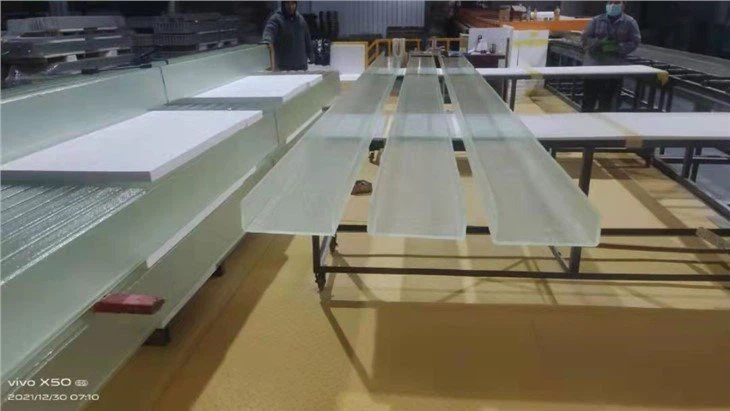
The annealing process is carried out in a special annealing lehr, which is a long, tunnel-like oven. The C Channel Glass is placed on a conveyor belt and slowly moves through the lehr, passing through different temperature zones. The temperature in each zone is carefully controlled to ensure that the glass cools at the correct rate.
Finishing
After annealing, the C Channel Glass undergoes a series of finishing processes to improve its appearance and performance. These processes may include cutting the glass to the desired length, polishing the edges to make them smooth, and applying a protective coating to prevent scratches and improve the glass's resistance to the elements.
Cutting the C Channel Glass is typically done using a diamond saw, which can make precise cuts without damaging the glass. Polishing the edges is usually carried out using a series of abrasive wheels, which gradually smooth the edges of the glass.
The protective coating can be applied in several ways, such as spraying or dipping. The coating can be made of various materials, such as silicone or polyurethane, depending on the specific requirements of the application.
Quality Control
Throughout the manufacturing process, strict quality control measures are in place to ensure that the C Channel Glass meets the highest standards. Quality control begins with the inspection of the raw materials to ensure that they are of the correct quality and composition. During the melting, shaping, and finishing processes, samples of the glass are taken at regular intervals and tested for various properties, such as thickness, strength, and optical clarity.
Any C Channel Glass that does not meet the quality standards is rejected and recycled back into the manufacturing process. This ensures that only the highest quality C Channel Glass is sold to customers.
Applications of C Channel Glass
C Channel Glass has a wide range of applications in the construction industry. It is commonly used in curtain walls, partitions, and skylights. Its unique shape provides excellent structural strength and can be used to create both functional and aesthetically pleasing designs.
For example, Clear Patterned U Channel Glass can be used to add a decorative element to a building's facade, while U Shaped Glass Panels are ideal for creating partitions that allow natural light to pass through. Low Iron U Glass For Curtain Wall is specifically designed for use in curtain walls, providing high transparency and excellent thermal insulation.
Conclusion
The process of making C Channel Glass is a complex and precise one that requires careful attention to detail at every step. From the selection of raw materials to the final finishing touches, each stage plays a crucial role in determining the quality and performance of the final product.
As a supplier of C Channel Glass, we are committed to providing our customers with the highest quality products. Our state-of-the-art manufacturing facilities and strict quality control measures ensure that every piece of C Channel Glass we produce meets the most demanding standards.
If you are interested in purchasing C Channel Glass for your next project, we would be delighted to discuss your requirements with you. Contact us today to start a conversation about how our C Channel Glass can enhance your construction project.
References
- "Glass Manufacturing: Principles and Processes" by David W. Scholes
- "Handbook of Glass Properties" edited by Helmut Scholze